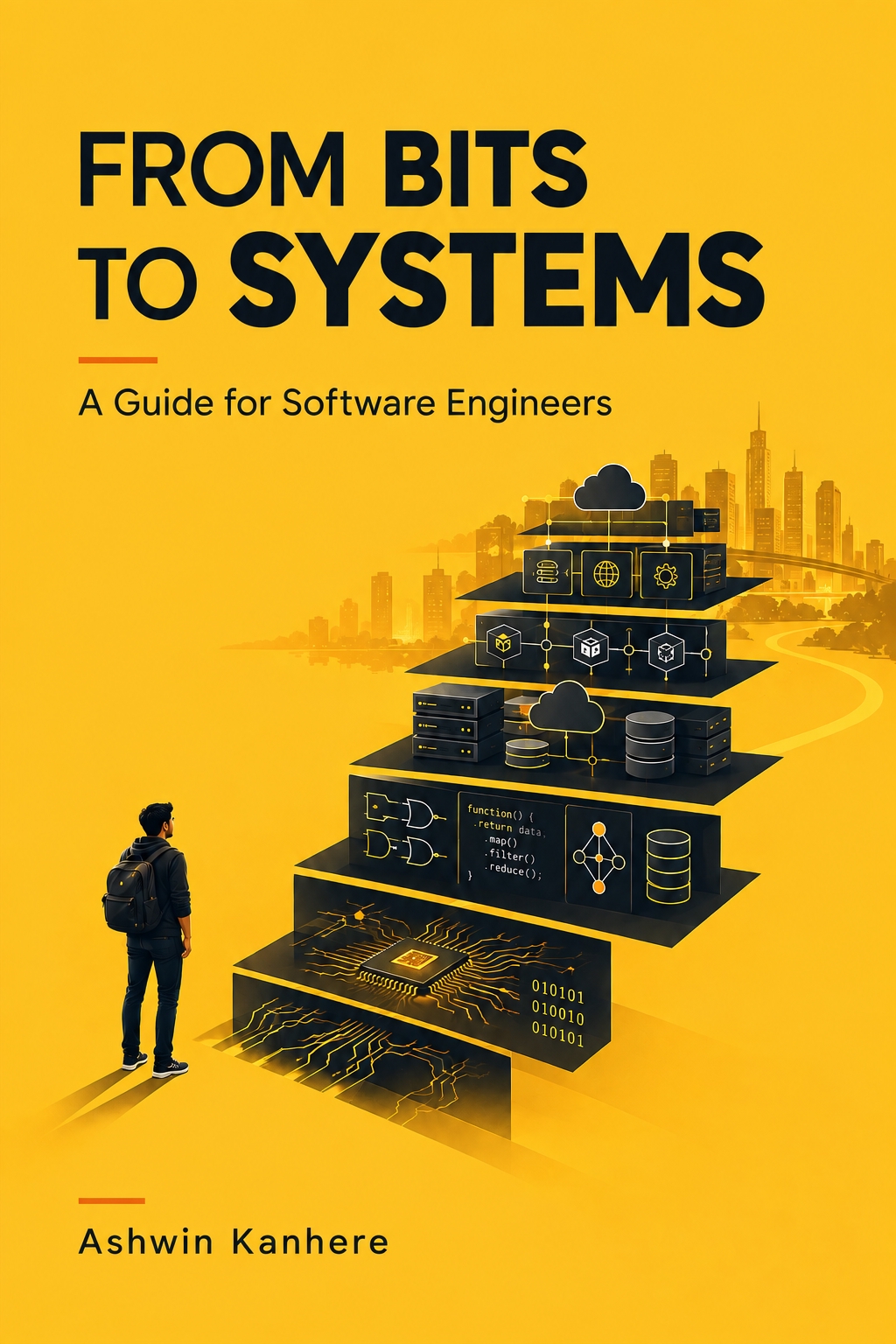
From Bits to Systems
A Guide for Software Engineers
The complete journey from the physical machine to your first production system — and your first job in India's tech industry. Eight parts. Forty-four chapters. Zero fluff.
Kindle edition · Available on Amazon.in · by Ashwin Kanhere
Written for the engineer who wants to understand why, not just how.
Most programming books are written from the outside looking in. This one is written from two decades on the inside — and it's specific to how software actually gets built and hired for in India.
- What your code is physically asking the hardware to do — and why a query that works in testing breaks in production.
- Why the cloud replaced on-premise infrastructure, and what specific services actually trade off.
- How real engineering teams ship: sprints, code reviews, CI/CD, incidents, and what on-call really means.
- How to evaluate AI claims critically and decide when AI adds engineering value — and when it doesn't.
- How India's hiring actually works: IT services vs product companies, placements, and your first 90 days.
- Syntax tutorial or language reference manual.
- Competitive programming or DSA-only guide.
- Book written for the US tech job market.
- Collection of interview questions without context.
It is the roadmap Ashwin uses to bring fresh graduates up to production speed at his own firm — written down so it can reach every engineer in training.
Eight parts. The full journey, layer by layer.
Before you can write software that runs well, you need to understand what it is running on. This part covers the four physical foundations of every computing system: memory, storage, the CPU, and the network. Each chapter follows a real-world use case from the Indian technology context.
From single-machine programs to distributed systems — how the web changed everything, how databases evolved, and how the infrastructure of modern software grew to serve billions of users. Includes relational databases, SQL, indexing, normalisation, and NoSQL.
Why the cloud replaced on-premise infrastructure, how cloud providers work, the economics of managed services, and how modern teams deploy, scale, and monitor applications without owning a single physical server.
From soil sensors to smart buildings — how physical devices generate data, how that data is collected and processed, and the software architectures that power industrial and consumer IoT systems. Drawn from real industrial experience.
A grounded, hype-free look at data science and AI — what machine learning actually does, where it fails, how LLMs work, and how to think about AI as an engineering tool rather than magic. Includes practical guidance on when not to use AI.
Agile, sprints, code reviews, CI/CD, incident management, product requirements — the complete picture of how professional engineering teams actually operate. What no textbook tells you about working in a real software organisation.
Readability, data structures, programming paradigms, performance optimisation, technical writing, and system design. Includes UPI's architecture as a case study in constraint-driven design. The enduring skills that outlast any specific technology.
IT services vs product companies, startup vs MNC trade-offs, the Indian hiring process decoded, how to build a visible portfolio from scratch, and the first 90 days as a professional developer. India-specific, honest, and actionable. The guide most books skip entirely.
 The author
Ashwin Kanhere
Twenty years building C++ systems for industrial hardware, enterprise platforms for connected buildings, and leading engineering teams through large multi-year projects. As Director of Appostrofy Technologies, he continues to hire, train, and build alongside engineers every day. From Bits to Systems is the exact roadmap he uses to bring fresh graduates up to production speed.
Book one of a trilogy in progress.
From Bits to Systems is the first book in Ashwin Kanhere's Foundation Series — a planned trilogy on software engineering for India's next generation of developers.
From Bits to Systems
The technical foundation — from hardware to your first production system.
From Systems to Products
How to go from writing code to owning and shipping a product.
From Products to Platforms
Architecture, organisation design, and building for scale.
Stop coding in a bubble. Start building systems.
Available now as a Kindle edition on Amazon.in. Not sure yet? Read the Introduction and Chapter 1 free — no strings.